What is the Prevalence and Nutrition Implications of Eating Disorders in Adolescents?
By Emma Wilson and Jessica Wilming
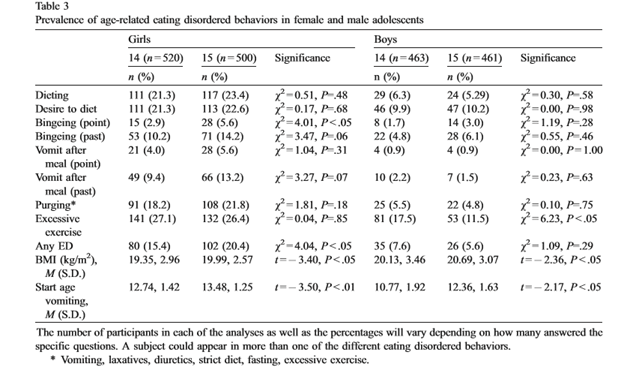
Introduction: What is the Impact of Eating Disorders on Adolescents? There is an increase in eating disorders among adolescents which can be prevented with education and proper nutrition. From height, to weight, to reproductive abilities, all can be affected by what and how you eat, especially from ages 7 to 17. The two most commonly known eating disorders are anorexia and bulimia. Anorexia is described as an individual who believes they need to lose weight, even if they are underweight; out of all women, .3% suffer from this disease. Bulimia is defined as eating a high consumption of food, then either forcing it back up via puking or taking a laxative. The female population has 1% suffering from Bulimia (Litmanen et al, 2017). A study done, found some eating disorders occur together and many adolescents both male and female are suffering (table 2). However, not all eating disorders are paired with body image disturbance (not liking or accepting the way your body looks) or the fear of gaining weight like the eating disorders we are commonly aware of. Eating disorders without body image disturbance, or the fear to gain weight are known as avoidant/restrictive food intake disorders (ARFID). The reason for not eating is not related to weight gain but something else. While the majority of those experiencing typical eating disorders are females, the majority of those with ARFID are males.
Research: A study done in 2017 gave students questionnaires regarding eating disorders. From the questionnaires they found the number of females suffering from eating disorders did not change during the study’s 10-year trial. However, during 2012 and 2013 more of the females reported experiencing eating disorder symptoms; just undiagnosed (Litmanen et al, 2017). Another study looked at 177 patients who were admitted to a partial hospitalization program for children and adolescents with eating disorders. The purpose of this study was to see how treatment for patients with an ARFID type eating disorder differed from typical eating disorders. Treatment while in the partial hospitalization program included different therapies as well as an educational component. Therapy included nutritional counseling for patients to learn what they need to eat to be meeting acceptable nutrient distributions. This meaning carbohydrates, fats, and proteins.
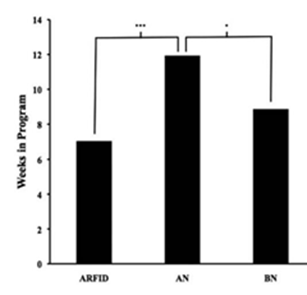
Synthesis: The impact of eating disorders in adolescents is that it is increasing, but going undiagnosed. Along with the increase in the number of affected individuals is the rise in different types of eating disorders. Some new disorders include binge eating, ARFID, Diabulimia, etc. When analyzing therapy used for eating disorders it was found that typically patients with eating disorders such as anorexia nervosa and bulimia nervosa, spent a longer time in a partial hospitalization program. As well for those with ARFID, it was found more beneficial to include many family-integrated therapy sessions. It was also found that typically patients with eating disorders such as anorexia nervosa and bulimia nervosa spent a longer time in a partial hospitalization program as seen in table 1. As well for those with ARFID, it was found more beneficial to include many family-integrated therapy sessions.
Litmanena J, Frojdb S, Marttunenc M, Isomaaf R, and Kaltiala-Heinog R (2017) Are eating disorders and their symptoms increasing in prevalence among adolescent population: NORDIC JOURNAL OF PSYCHIATRY, 2017 VOL. 71, NO. 1, 61–66
http://dx.doi.org/10.1080/08039488.2016.1224272
Kaplan Seidenfeld, M. E., Sosin, E., & Rickert, V. I. (2004). Nutrition and Eating Disorders in Adolescents. Mount Sinai Journal of Medicine, 71(3), 155-161.
Kjelsas E, Bjornstrom C, Goetestam K.G. (2004) Prevalence of Eating Disorders in Female and Male Adolescents (14-15 years): Eating Behaviors 2004, VOL. 5, 13-25
Ornstein, R. M., Essayli, J. H., Nicely, T. A., Masciulli, E., & Lane‐Loney, S. (2017). Treatment of avoidant/restrictive food intake disorder in a cohort of young patients in a partial hospitalization program for eating disorders. International Journal of Eating Disorders, 50(9), 1067-1074. doi:10.1002/eat.227
 What is the Prevalence of Eating Disorders in Adolescents?